


Quais amplificadores Sinbosen suportam entradas digitais AES/EBU?
Achieve Full-Chain Lossless Audio: A Selection Guide to Sinbosen AES/EBU Amplifiers
In professional audio engineering—from large-scale live performances to stadium installations and high-end venues—signal purity directly dictates sound quality. To meet the demanding requirements of low latency, high noise immunity, and maximum fidelity, multiple Sinbosen amplifier series equipped with DSP (Digital Signal Processing) now natively feature AES/EBU digital audio interfaces.
Quick Primer: What are AES, EBU, and AES3?
When reviewing rear panels or specification sheets, you may encounter terms like AES, EBU, or AES3. These all refer to the same international digital audio transmission standard:
AES (Audio Engineering Society) and EBU (European Broadcasting Union) jointly established this standard, which is why the industry commonly combines them as AES/EBU.
AES3 is the official technical specification designation for this protocol.
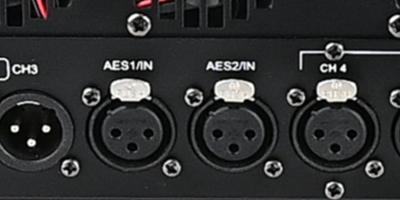
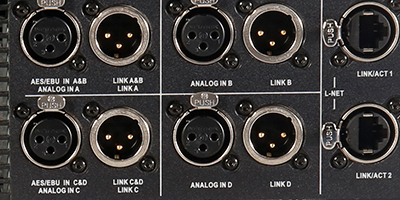
Physical Interface: On Sinbosen amplifiers, AES/EBU uses standard 3-pin XLR connectors. Simply connect using a 110 Ohm (110Ω) professional digital balanced cable to transmit two channels of uncompressed digital audio over a single line.
Why Choose AES/EBU Digital Transmission?
Compared to traditional XLR analog inputs, utilizing AES/EBU digital transmission offers three major advantages for pro audio systems:
Full-Chain Lossless Audio: Digital signals from your mixing console pass straight to the amplifier without multiple Analog-to-Digital or Digital-to-Analog (A/D & D/A) conversions, preserving maximum dynamic range and audio detail.
Superior Noise Immunity: Utilizing 110 Ohm balanced digital transmission eliminates ground loop noise, RF interference, and high-frequency degradation commonly caused by complex stage electromagnetic environments over long cable runs.
Streamlined Cabling: A single digital cable carries two audio channels simultaneously, significantly reducing main cable runs, setup time, and transportation costs.
Sinbosen "AES/EBU Input" Amplifier Lineup
Selection Tip: Because AES/EBU is a digital protocol, it relies on an internal DSP chip for decoding and signal processing. Within the Sinbosen lineup, AES/EBU interfaces are exclusively featured on models configured with DSP.| Touch Screen DSP-SERIES(DSP10000Q etc.) | A-4X(LA-DSP Version) | A-12X1(LA-DSP Version) Please note that the DFM software version does not support AES. |
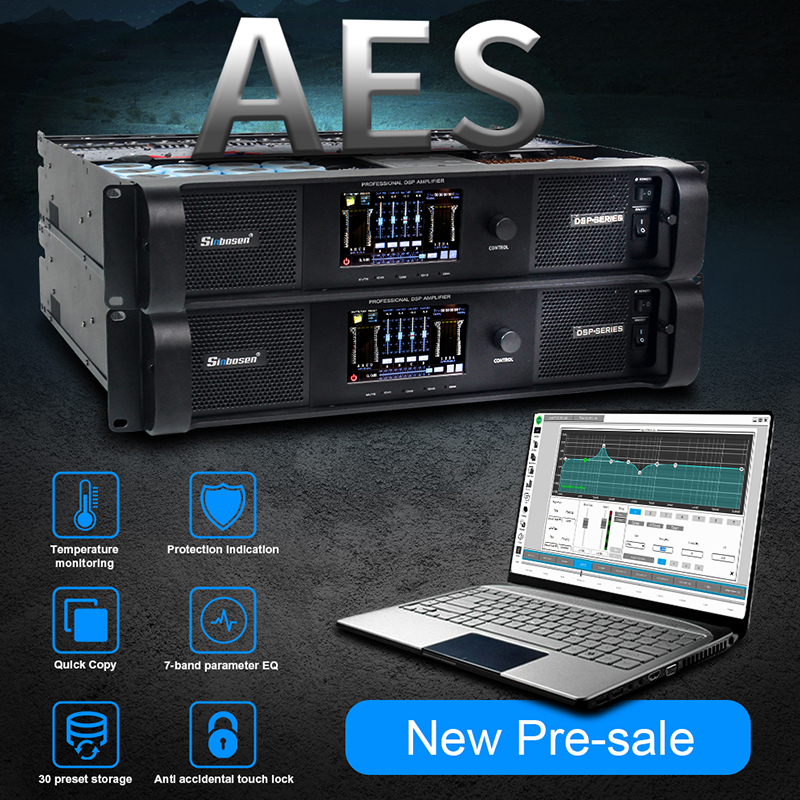 |
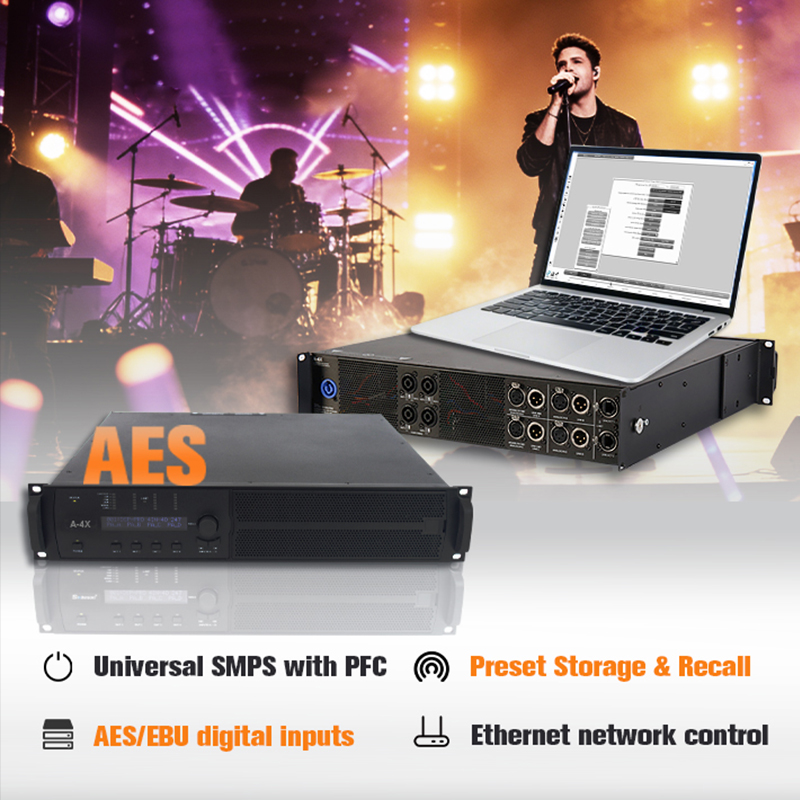 |
 |
 |
 |
 |
System Setup with Sinbosen AES Amplifiers
Signal Input: Run a 110 Ohm (110Ω) digital XLR cable from the AES OUT of your digital console or audio processor to the AES IN port on the amplifier's rear panel.
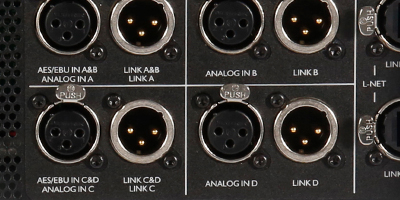
Lossless Daisy-Chaining: If you have multiple amplifiers in a rack, use the AES LINK/OUT port to pass the digital signal to the next amplifier in a lossless chain—no external audio distribution amplifiers required.
Whether for large touring productions or high-end fixed installations, Sinbosen AES/EBU-enabled DSP amplifiers provide clean, reliable, and powerful drive for your loudspeaker systems.
FAQ
1. What Do AES Inputs and Outputs Do on an Amplifier?
AES Input (AES IN):
Role: "Receiving the Signal"
Accepts raw digital audio data directly from a digital mixing console or loudspeaker processor. The signal is sent to the amplifier's internal DSP for decoding, EQ/Limiting processing, and power amplification to drive the speakers.
AES Output (AES LINK / OUT):
Role: "Forwarding / Daisy-Chaining"
This output is not for connecting speakers. Instead, it passes an exact, uncompressed clone of the digital signal coming into AES IN directly through to the next amplifier in the rack.
2. Why Do Amplifiers Feature Inputs vs. Outputs?
Labeled "AES IN": Indicates the amplifier can receive and process incoming digital audio signals.
Labeled "AES LINK / OUT": Indicates the amplifier supports loop-through daisy-chaining.
Standard Professional Configuration (e.g., Sinbosen DSP Amplifiers): Most professional units feature both AES IN and AES LINK (OUT) on the rear panel. This allows you to patch the AES LINK of Amplifier #1 directly into the AES IN of Amplifier #2 without needing an external signal distributor.
3. Can an Amplifier Have "Only Inputs" or "Only Outputs"?
A. Are there amplifiers with ONLY AES Inputs (no AES Output)?
Answer: YES (Very Common).
Why: To reduce manufacturing costs or save rear-panel space (especially in compact 1U chassis units). An "Input-Only" amplifier still receives full digital audio, but you cannot daisy-chain directly from its back panel to another unit.
B. Are there amplifiers with ONLY AES Outputs (no AES Input)?
Answer: NO (Logically Impossible for Amplifiers).
Why: A power amplifier is an end-point playback device. Its core job is to receive a signal and amplify it to drive speakers. If an amplifier lacked an AES input, it couldn't receive digital audio in the first place—making an AES output completely useless.
(Note: Devices that generate AES outputs without taking an AES input are source equipment, such as digital wireless mic receivers, CD players, or digital mixing consoles.)
Contact us:
 sales2@sinbosen.com
Whatsapp:https://api.whatsapp.com/send?l=en&phnoe=8616676738225
Website:https://www.sinbosenaudio.com/

